














INDUSTRY STANDARDS & COMPLIANCE
SANS 1313 | SANS 1173:2013 | SANS 971:2013 | SANS 968:2013 | SANS 1366:2013

There
are
two
categories
of
Idlers,
basically
Carrying
Idlers
and
Return
Idlers
.
However
within
these
two
categories
there
are
a
number
of
different
Idler
Sets
which
suit
various
applications.
They
are
specifically
designed
to
suit
those
operations
so
as
to
minimize
friction,
increase
material
carry
and
alleviate
unnecessary
stress
on
the Conveyor Belt.
Pulleys
are
used
on
Conveyors
to
Support
and
Deflect
the
belting
through the Conveyor Structure ranging from:
•
Cast Iron Pulleys
•
Slatted Pulleys
•
Crowned Pulleys
•
Fabricated Steel Pulleys etc.
Where
Return
Idler
Sets
comprises
of
two
rolls,
a
Support
Frame
is
required
which
supports
the
Idler
Pair
and
attaches
the
Idlers
to
the
Conveyor Frame.
This
2-roll
design
forms
the
Return
Belt
into
a
'V'
Trough
and
these
Return
Idler
sets
are
referred
to
as
'V'
Return
Idlers.
The
Trough
angle
of
the
'V'
Return
Idler
is
usually
10
degrees
and
this
feature
has
been
developed
to
assist
with
Belt
training
along
the
Return
Strand.
In
addition
to
the
fixed
base
frames
for
Return
Idlers,
Garland-Type
Return
Idlers
are
also
available.
Which
like
their
equivalent
Troughing
Idlers
are
more
tolerant
of
Conveyor
Structure
misalignment.
Worldwide Conveyor are Suppliers of
Pulleys up to 600mm in diameter.
We manufacture for and supply to the
Mining and Industrial markets.
There are a Number of Different Types of Pulleys available for use
on Conveyors as well as different Design Parameters for Pulleys
serving Different Functions on the same Conveyor.
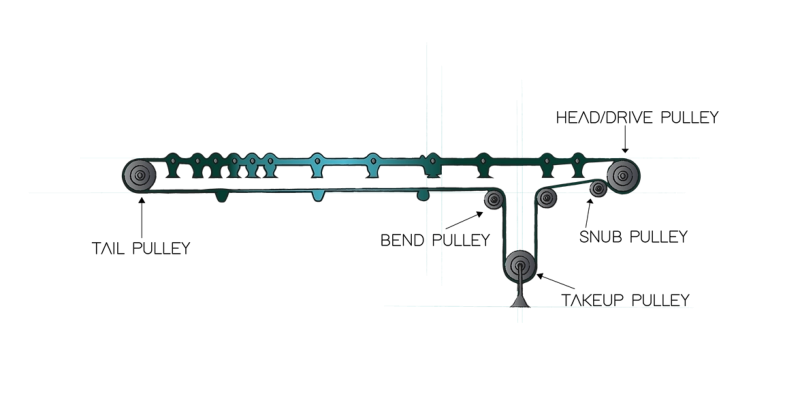
The
Head/Drive
Pulley
is
located
at
the
Discharge
Terminus
of
the
Conveyor.
It
provides
the
Driving
Force
for
the
Conveyor.
In
order
to
increase
Pulley
life
and
traction,
it
often
has
a
larger
diameter
than
other
pulleys.
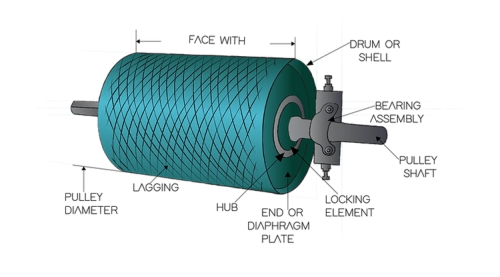
Worldwide can supply Pulleys with Hot Vulcanized Rubber Lagging.
Plain
or
Grooved,
as
required
by
the
Client.
Different
patterns
of
grooving
such
as
Herringbone
or
Diamond
can
be
provided
to
increase Tractive Friction under Dirty or Wet Conditions.
Diamond
grooves
have
the
Advantage
of
being
installed
in
any
orientation, regardless of Belt direction.
The Bend Pulley is used for Changing the Direction of the belt.
It’s
usually
installed
at
the
Tail
Part
or
the
Vertical
Take
Up
Equipment
Part
when
the
belt
direction
needs
a
180°
bending.
Or
above
the
Take
Up
Equipment
Part
for
a
90°
bending.
The
Pulley
which
is
used
for
Extending
the
Contact
Surface,
is
usually
used for below or equal to 45° bending.
The
Surface
Treatment
of
the
Bend
Pulley
can
be
Smooth
Steel
or
Flat Rubber Lagging.
a
Pulley
which
is
provided
to
Increase
or
Decrease
Warp/Contact
angle
on
the
belt
or
nearby
Pulley.
To
support
an
empty
Conveyor
Belt in its return.
They
also
provide
a
Mechanism
whereby
the
Conveyor
Belt
can
be
trained to run (track) true along the Conveyor Idlers.
Generally
Pulleys
are
located
at
the
ends
of
the
Conveyor
Structure
and
at
the
Take-Up
arrangement.
Pulleys
are
used
to
transmit
the
Drive
power
into
the
Conveyor
Belt
and
as
such,
are
subjected
to
the
Dynamic Belt Tension Forces in a Conveyor.
INDUSTRY STANDARDS & COMPLIANCE
SANS 1313 | SANS 1173:2013 | SANS 971:2013 | SANS 968:2013 | SANS 1366:2013











WORLDWIDE CONVEYOR GROUP OF COMPANIES
COPYRIGHT @ 2026 | WORLDWIDE CONVEYOR GROUP OF COMPANIES | designed by jacqueline designs


COPYRIGHT @ 2026 | WORDLWIDE CONVEYOR GROUP OF COMPANIES
designed by jacqueline designs


WORLDWIDE CONVEYOR GROUP OF COMPANIES